


Aramak için enter tuşuna veya kapatmak için ESC tuşuna basın

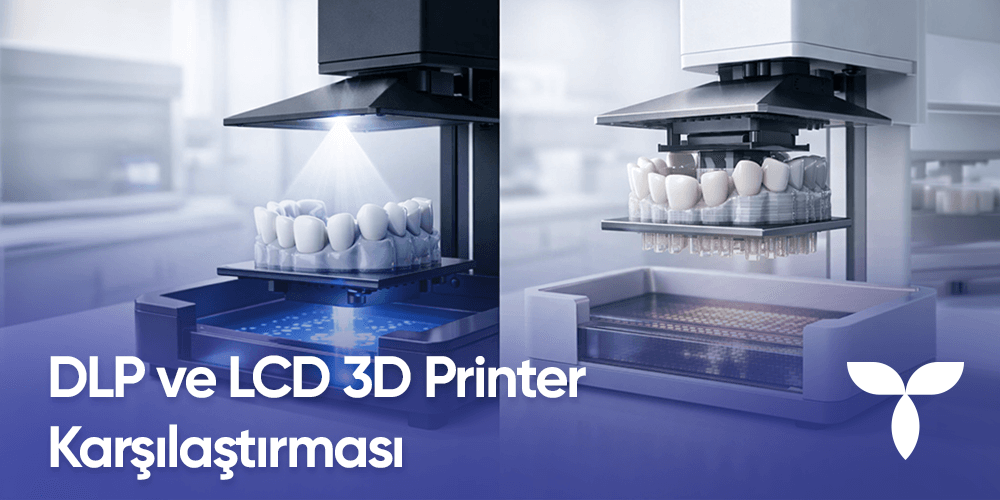
DLP vs. LCD 3D Printer Comparison
DLP vs. LCD 3D Printers: Which Technology Is More Advantageous for Dental Manufacturing?
In digital dentistry, choosing the right 3D printer is a critical decision that directly affects the quality and efficiency of in-house production. Two main resin-based printing technologies are commonly used in dental applications: LCD (MSLA) and DLP. While both technologies cure light-sensitive resins layer by layer, they differ significantly in terms of performance, durability, and long-term cost.
In this article, we compare DLP and LCD technologies in detail and explain, based on technical data, why DLP 3D printers are generally more advantageous for dental applications.
1. Print Quality and Accuracy
LCD (MSLA)
LCD printers cure resin by passing UV light through a large LCD screen. As a result:
- Each pixel acts as a separate light source,
- Pixel borders can create microscopic “scan line” artifacts,
- Multiple light sources may cause tonal variations across the model.
In high-tolerance dental applications such as splints or surgical guides, even these small variations can affect the final outcome.
DLP (Digital Light Processing)
DLP technology uses a single powerful projector to cure the entire layer at once. This provides:
- Smoother and more uniform pixel boundaries,
- Sharper details,
- Even light distribution across the build area.
Result: Because precision is critical in dental manufacturing, DLP printers deliver more consistent and accurate results.
2. Durability and Service Life: LCD Screen vs. DLP Projector
The Weak Point of LCD Printers: Screen Lifetime
Because LCD panels are constantly exposed to UV light, they tend to suffer from:
- Pixel degradation,
- Reduced light transmission,
- Uneven light distribution over time.
In most LCD printers, screens start to lose performance after 500–2,000 hours. This means:
- The screen must be replaced,
- Additional cost is incurred,
- Production downtime and service interruptions occur—an important drawback for dental clinics.
The Advantage of DLP Printers: Long-Life Projector Systems
DLP printers use a UV-resistant DLP projector instead of an LCD screen. This system:
- Has a much longer lifespan,
- Maintains stable light intensity for years,
- Does not require frequent replacement.
Result: In long-term use, DLP printers offer lower maintenance costs and greater operational continuity.
3. Light Uniformity: The Key to Dental Quality
In dental applications such as surgical guides, models, splints, and aligners, light uniformity is one of the most important factors affecting print quality.
- In LCD printers, light comes through LED arrays, which may vary in intensity.
- In DLP printers, a single projection source provides perfectly uniform light distribution.
This difference is especially noticeable in:
- Surgical guides
- Clear aligner models
- Endodontic guides
- Mock-up models
In these applications, the homogeneous light of DLP technology directly improves dental accuracy.
4. Speed: DLP Offers Layer-Independent Printing
In LCD printers, printing speed depends on the curing time of the resin.
In DLP printers, because the projector cures the entire layer at once:
- Printing one part or ten parts takes the same amount of time.
- This provides a major time advantage for high-volume production.
For in-clinic serial manufacturing, DLP is significantly more efficient.
5. Long-Term Cost Comparison
| Criteria | LCD | DLP |
| Initial investment | Lower | Medium |
| Screen / projector lifespan | Low | High |
| Maintenance cost | High (screen replacement) | Very low |
| Print accuracy | Medium | Very high |
| Suitability for dental use | Moderate | Professional level |
In summary, while LCD printers may seem attractive due to their lower initial cost, DLP printers offer superior precision, durability, consistency, and long-term cost efficiency, making them the preferred choice for professional dental manufacturing.
Related News

Dt. Burak Yeşilova | Tolard Stories
September 1, 2026

Dt. Emrecan Eren | Tolard Stories
September 1, 2026
